
If you are a CEO or HR leader considering virtual reality for employee training, you have probably already looked at headsets. The hardware is impressive. The demos are convincing. The price tags are getting friendlier. It is easy to believe that buying the devices is the hard part and everything else will fall into place.
It will not.
The headsets are only the last mile. The real work, the part that determines whether your VR training actually changes how employees perform, happens before anyone puts a device on their head. Skip that work, and you are left with expensive hardware and no measurable improvement.
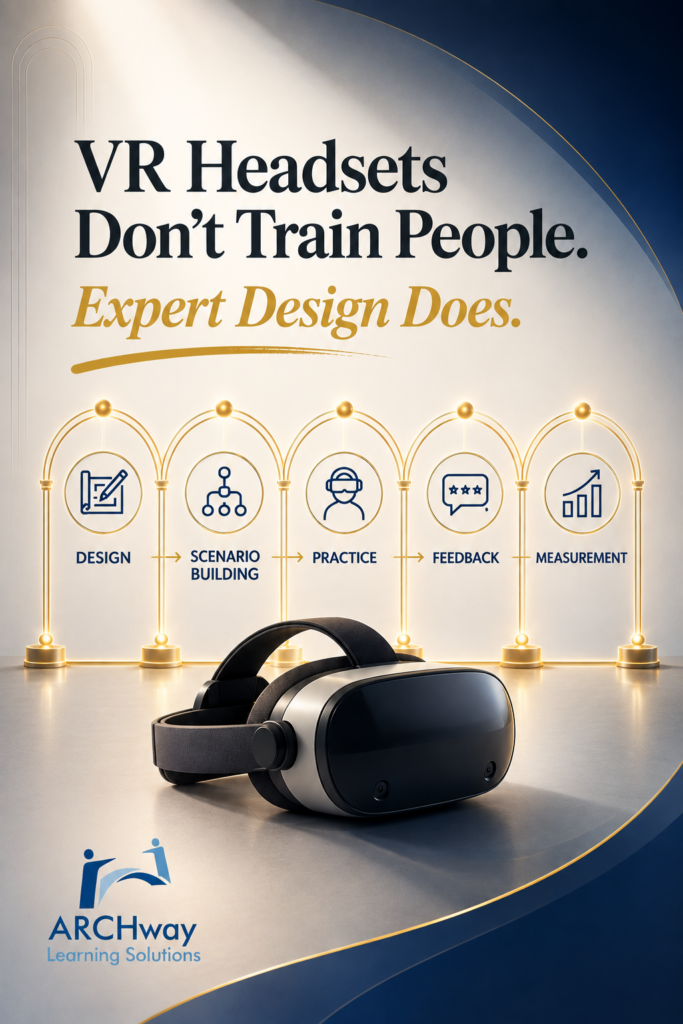
Companies are rushing into VR training. The global market is projected to reach tens of billions within the next few years, driven by falling hardware costs and a growing recognition that traditional training often falls short on engagement, retention, and real-world application. PwC research found that VR learners were four times more focused during training than e-learning peers and felt 275 percent more confident applying skills after VR practice. Those numbers are real. They are also the reason your competitors are paying attention.
But here is the part that does not make the headlines: every one of those results came from VR programs that were intentionally designed by learning experts. The headset was the delivery mechanism. The instructional design was the engine.
It is an understandable mistake. When you invest in something as tangible as VR headsets, the hardware feels like the decision. You can see it, hold it, and show it to your board. It looks like progress.
The learning design, by contrast, is invisible. It is the structure, the scenario logic, the feedback loops, the assessment strategy, the way practice is sequenced so skills build on each other. None of it photographs well in an annual report. But it is the only part that changes behavior.
Think of it this way: buying VR headsets without expert instructional design is like buying surgical tools and expecting a layperson to perform surgery. The tools are necessary but insufficient. What matters is the system, the skill, the method, and the experience behind them.
Too many organizations learn this the hard way. They purchase hardware, assign an internal team to figure out the content, launch a pilot that underwhelms, and conclude that VR training does not work. It did not work because it was never designed to work.
Also read: Why VR Training Fails Without Strong Learning Design
When a learning expert designs a VR training program, they are not recording a 360-degree video or converting a PowerPoint into a headset-friendly format. They are building an experience.
It begins with defining exactly what the employee needs to do differently after training. Not in broad terms like communicate better or be more safety-conscious, but in observable, measurable actions. The design flows backward from those outcomes. If you cannot describe the behavior change, you cannot design for it.
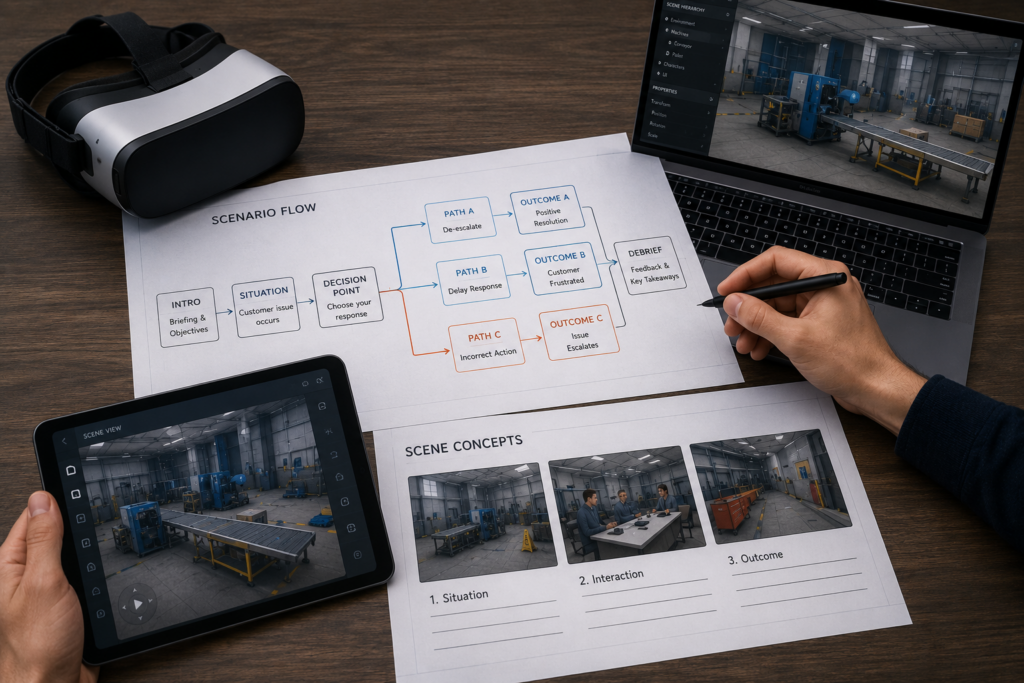
Scenarios are built to simulate actual job situations. A warehouse supervisor does not need to read about safety protocols. They need to walk through a virtual warehouse, spot hazards, make decisions under time pressure, and see the consequences of their choices. A retail manager does not need to memorize de-escalation steps. They need to practice handling an escalating customer interaction with branching outcomes that change based on what they say and do.
This is where VR earns its reputation. Traditional training tells you what to do. VR lets you practice doing it, fail safely, and try again. That active repetition is what builds real confidence and competence.
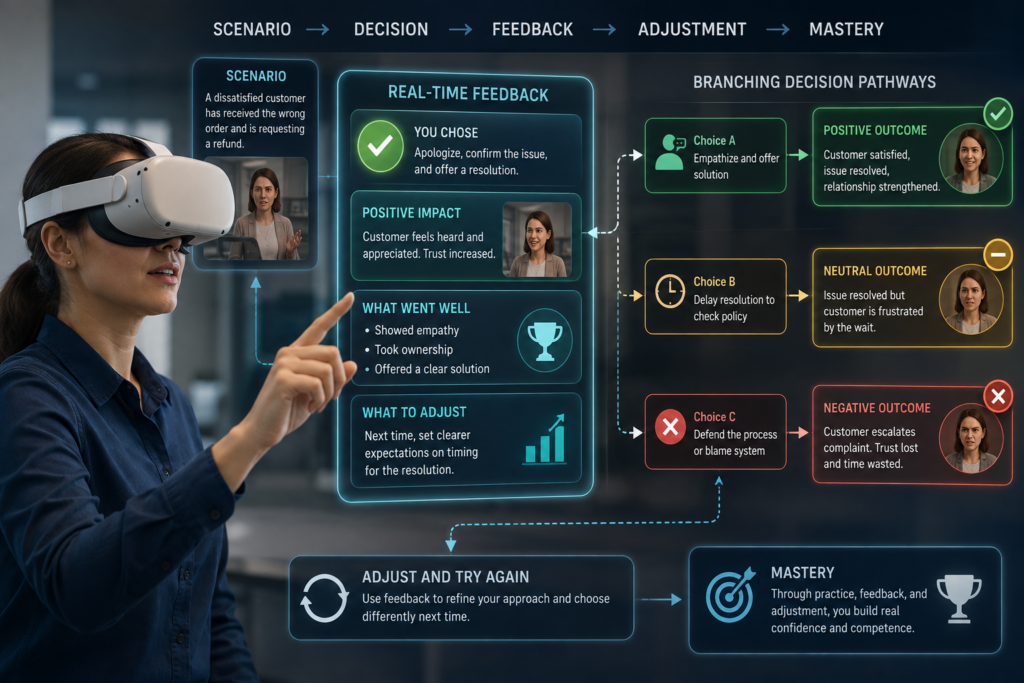
The feedback architecture matters just as much. In a well-designed VR module, the learner sees the result of their decision, not just a correct or incorrect screen, but the downstream impact on the team, the customer, or the process. That is how adults actually learn: through experience, reflection, and adjustment.
A VR module designed by an expert includes embedded assessments that track more than completion. Decision speed. Accuracy. Process adherence. Improvement across attempts. These are data points a headset alone cannot capture. The design has to bake them in from the start. This is the kind of design work that separates a working VR program from an expensive shelf decoration, and it is exactly what a dedicated VR learning partner brings to the table.
Companies that invest in expert-designed VR training are pulling ahead in measurable ways.
In manufacturing, VR-trained workers reach competency faster and with fewer safety incidents than those trained through traditional observation. In healthcare, VR-trained nurses show higher procedural accuracy and confidence before ever touching a patient. In retail and hospitality, VR-trained staff demonstrate better soft skills and faster onboarding than peers trained through e-learning alone.
Also read: Why Smart Businesses Are Moving Safety Training into VR
What these organizations share is not better headsets. It is better design. They partnered with learning experts who understood adult learning science, instructional architecture, and VR’s unique capabilities. They did not treat VR as a replacement for trainers. They treated it as a new medium that requires new thinking. The headset is not the strategy. The design is, and that is where an experienced learning partner changes the outcome.
The ROI gap between buying headsets and designing a VR program is stark. One approach leaves you with devices collecting dust and a frustrated internal team. The other produces faster onboarding, higher skill retention, fewer safety or compliance failures, and a workforce that actually feels prepared.
If you are serious about VR training, here is the sequence that works.
Are you trying to reduce safety incidents? Shorten onboarding? Improve customer interactions? Build leadership readiness? The problem drives the design, not the other way around. Get specific about what success looks like before anyone talks about hardware.
Look for learning experts who ask about your business outcomes before they talk about their equipment. The right partner wants to understand your workforce, your pain points, your training gaps, and how you will measure success. If the conversation starts and ends with headset specs, keep looking.
A good design-and-build phase takes longer than the hardware procurement phase. Scenarios need time to develop, test, and refine. Rushing this part guarantees a mediocre result regardless of which headset you bought.
Run a controlled pilot with a defined group, clear success metrics, and a plan for iteration. Collect performance data, not just satisfaction surveys. Compare results against your current training method so you have a real business case for scaling.
VR training is not a one-time event. You need a partner who can update scenarios as your processes change, onboard new cohorts, and keep the program fresh. The ongoing relationship matters as much as the initial build.
Also read: How to Build a World-Class Virtual Training Program for Your Organization
When executives hesitate on VR training, they usually cite cost. But enterprise headsets are now a few hundred dollars per unit. Cloud-based content management means you do not need an IT army to deploy updates. The cost argument is getting weaker by the year.
The real barrier is the willingness to invest in the invisible work, the design, the scenario building, the measurement strategy, the iteration. That is what separates a VR training success story from an expensive shelf-decoration project.
Your competitors who are getting results from VR training did not buy better headsets than you. They bought better thinking. They recognized that technology delivers the experience, but expert design delivers the outcome. That is the work we do at ARCHway: we design and build VR training programs for organizations, from the first business outcome to the final performance metric.
The question is not which headset to buy. It is whether you will design training that actually works, or buy hardware and hope for the best.
No. VR is increasingly used for leadership development, difficult conversations, customer service, and other soft-skill scenarios. Practicing in a realistic environment builds confidence faster than reading or watching, regardless of the subject matter.
A focused single-module program can take eight to twelve weeks from design to pilot-ready delivery. More comprehensive programs with multiple scenarios and assessment layers typically take three to six months. The timeline depends on complexity, not on headset availability.
Not necessarily. Most modern VR training works in a small cleared area with minimal setup. The key is having a partner who designs for your available space and delivery model, whether that is a training room, a quiet corner, or a remote setup.
Well-designed VR training is intuitive. Most users become comfortable within minutes. A good instructional design includes a short orientation that removes the friction before the real training begins. If your VR training feels complicated, that is a design problem, not a user problem.
Expert-designed programs include embedded performance metrics: decision accuracy, time-to-competency, scenario scores across attempts, and correlation with on-the-job performance. These metrics should be defined in the design phase, not discovered after launch.
You can buy headsets from a dozen vendors. What you cannot buy off the shelf is the instructional design that makes VR training actually change how your people perform.
Visit archwaylearningsolutions.com to learn how our VR training programs combine expert instructional design with immersive technology to deliver measurable workforce results. Contact us today for a strategic consultation on building a VR training program that works.
Where does your organization stand on VR training? Have you already piloted it, or are you still weighing the decision? We would genuinely love to hear about your experience in the comments: the wins, the surprises, and the lessons learned. And if you are ready to explore expert-designed VR training for your team, visit archwaylearningsolutions.com to see how we help, or book a no-pressure consultancy call for a straight answer on whether VR is the right move.