Ask most employees about their last training session and you will usually hear the same story. A long slide deck. A full hour blocked on the calendar. A quiz nobody remembers by the next afternoon.
For years, companies have treated training as something to deliver rather than something employees wanted to receive. In 2026, that gap is getting expensive. Strong employees have options, and they use them.
If development feels like a chore, people tune out or move on. The good news is that what employees actually want from training is no longer a mystery. It is practical, relevant, and genuinely useful. Here is what that looks like, and how leaders can deliver it.
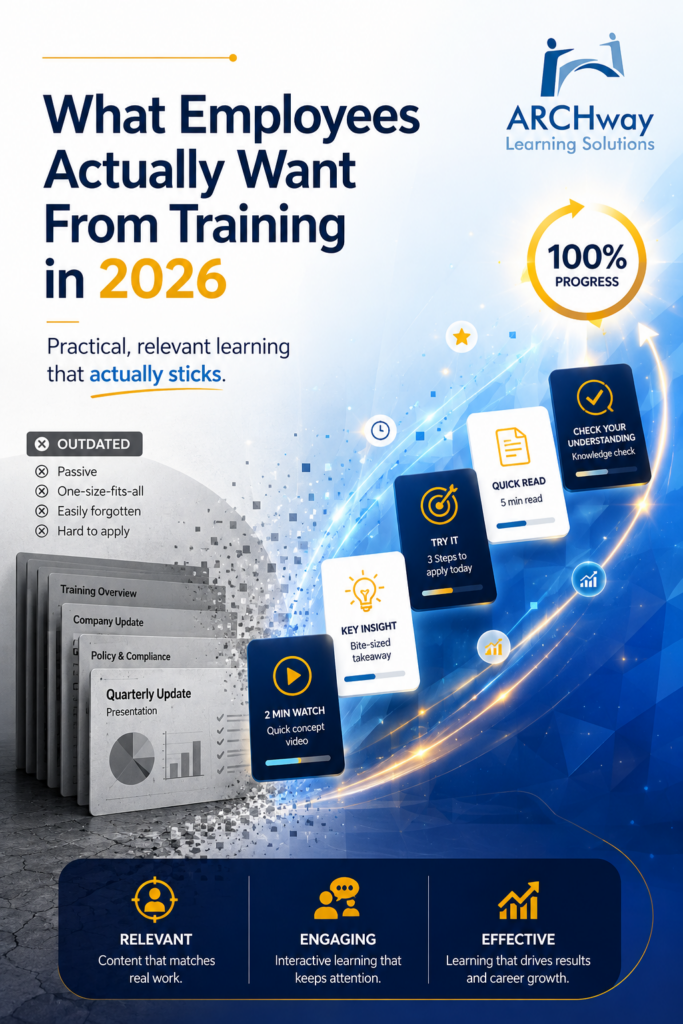
Employees do not dislike learning. They dislike wasting time. The frustration with corporate training rarely comes from the topic. It comes from the delivery.
Too much workplace training is still built as a one-way information dump. A speaker clicks through slides. A video plays on a loop. A long document gets emailed to a team that never opens it. The content may be accurate, but it is not designed to be used. It is designed to be completed.
That distinction matters more than most leaders realize. Employees can tell the difference between training built to check a compliance box and training built to help them do their job better. When they sense the first one, they check out. When they experience the second, they lean in.
Part of the problem is how we measure success. A full training room feels like progress. A completed module feels like progress. But if nothing changes on the job afterward, the room was just busy, not developed.
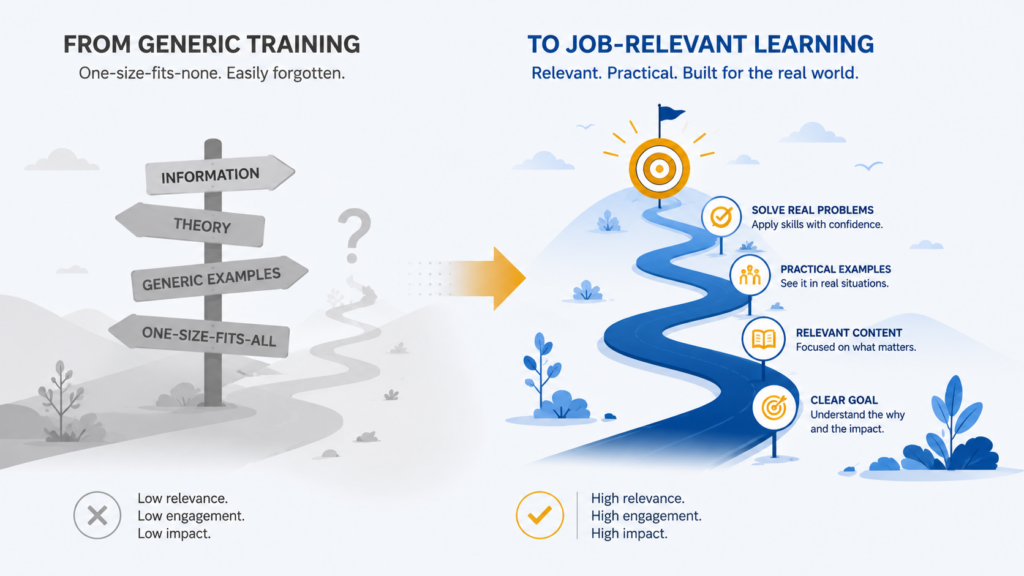
The single biggest thing employees want from training is relevance. They want to learn things that connect to their actual work, their actual tools, and their actual challenges.
Generic training is easy to spot. It uses examples from a different industry. It teaches skills in the abstract. It never answers the question every employee is silently asking: how does this help me do my job?
Relevant training does the opposite. It uses real scenarios from the workplace. It shows how a new skill applies to a real task, a real customer, or a real deadline. When people can see a direct line from what they are learning to what they will do on Monday, engagement rises on its own.
This is one reason expert-led learning and development has become so valuable. A strong partner takes time to understand the organization, the roles, and the daily realities before building the experience. Relevance is not a nice-to-have. It is the whole game.
Modern employees do not want a four-hour workshop for a topic that could be covered in twenty focused minutes. They want learning that fits the rhythm of their workday, not the other way around.
Microlearning has grown for exactly this reason. Bite-sized lessons, short videos, quick practice tasks, and focused modules let people learn in the gaps between meetings, at the start of a shift, or in small doses across a week. The goal is not to pack less in. It is to make each piece easier to absorb and apply.
Flexibility matters just as much. Frontline teams, remote workers, and shift-based employees do not all learn at the same time or in the same place. Training that respects that reality gets completed and remembered. Training that ignores it gets skipped.
The best learning experiences blend structure with flexibility. There is a clear path, but people can move through it at a pace that works for them, on a device that is actually available to them.
People do not learn a skill by watching it once. They learn it by doing it, making mistakes safely, and trying again. This is the biggest difference between training that sticks and training that evaporates.
Real practice can look like role-playing a difficult customer conversation, working through a realistic scenario with a teammate, or applying a new process to a sample problem. The point is to move from hearing about a skill to actually performing it.
This is where newer tools are changing what is possible. Virtual reality training, for example, lets employees rehearse hands-on situations in a safe, controlled environment. Instead of reading about how to handle a safety incident or a complex procedure, a learner can walk through it. The technology does not replace good design. It gives good design a more powerful way to create realistic practice.
Also read: VR Headsets Don’t Train People. Expert Design Does.
When practice is built in, training stops being an interruption and starts being preparation.
Employees want to leave training with something they can actually use. Not a vague sense of inspiration. Not a folder full of slides. A skill.
That means the best training is built around outcomes, not topics. Instead of asking what do we need to teach, strong programs ask what do people need to be able to do. The difference changes everything.
A customer service program built around topics might cover company history, product features, and communication principles. A program built around outcomes would focus on handling an upset customer, resolving a billing question, or de-escalating a tense call. One feels like school. The other feels like support.
When employees finish a session and immediately apply it to their work, they do not just remember the content. They feel more capable. That confidence is what turns training from an obligation into a benefit.
Modern employees, especially experienced ones, do not respond well to being talked down to. They bring real knowledge and real opinions into every session. Training that ignores that will lose them in the first ten minutes.
Good learning experiences respect what people already know. They acknowledge experience instead of lecturing past it. They invite questions, discussion, and real examples from the room. They treat adults like adults.
This is a core principle of adult learning. People learn best when content connects to what they already know, when they have a say in the process, and when they can see why the learning matters to them personally.
When training respects people, it stops feeling like a punishment and starts feeling like an investment in them. That shift alone can change how the whole organization thinks about development.
Employees do not just want a training session. They want a path. They want to know that the time they invest in learning leads somewhere: a new skill, a stronger role, a clearer future.
That is why the best workforce learning connects to growth. It shows people what they are building toward. It gives them feedback along the way. It celebrates progress instead of only marking completion.
When development feels connected to a career, employees engage differently. They take ownership. They ask better questions. They seek out the next step instead of waiting to be told. For employers, that is exactly the kind of workforce you want to build and keep.
Also read: The Hidden Cost of Untrained Managers.
Employees want training that is practical, relevant, and easy to apply. They value short, focused learning over long slide decks, real practice over passive lectures, and content that connects directly to their job.
Traditional training often feels generic and disconnected from daily work. When content is not relevant, runs too long, or is delivered as a one-way presentation, employees check out quickly. They tune out because the training does not respect their time or their experience.
Microlearning breaks content into short, focused lessons that fit into the workday. It works because people absorb and apply small pieces more easily, and it respects the flexible schedules of modern, remote, and shift-based teams.
Virtual reality training lets employees practice realistic, hands-on situations in a safe environment. It is especially useful for safety, procedures, and skills that are hard or risky to rehearse in real life. The technology works best when it supports well-designed learning, not as a replacement for it.
Start with relevance and outcomes. Use real scenarios, build in practice, keep lessons short, and connect the learning to career growth. Treat employees as experienced adults and invite their questions and input.
Better training can reduce turnover, improve productivity, and build skills that employees actually use. When learning is relevant and practical, people feel more capable and more invested, which supports retention and performance over time.
What employees want from training has not really changed. They want to learn things that matter, in a way that respects their time, and to leave with skills they can actually use. What has changed is how clearly the market rewards the companies that deliver on that.
When training becomes practical, relevant, and human, it stops being a cost and starts being a competitive advantage. People stay longer, perform better, and grow into the leaders the organization will need next.
If your team is ready to move beyond the slide deck, visit www.archwaylearningsolutions.com to learn more, or contact us for a strategic consultancy session.