
For years, safety and compliance training has relied heavily on presentations, manuals, and checklists. While those methods can communicate important information, they do not always prepare employees for the pressure of real situations.
On the other hand, most workplace accidents do not happen because people never heard the rule. They happen because knowing something is not the same as doing it under pressure.
That is where the rubber meets the road. In high-risk environments, traditional safety compliance training often checks the box without changing behavior in the exact moment that behavior matters most.
That is exactly where VR changes the conversation. It gives teams a way to practice dangerous situations without exposing anyone to real danger, while giving leadership something far more useful than attendance sheets: evidence, patterns, and trackable readiness.
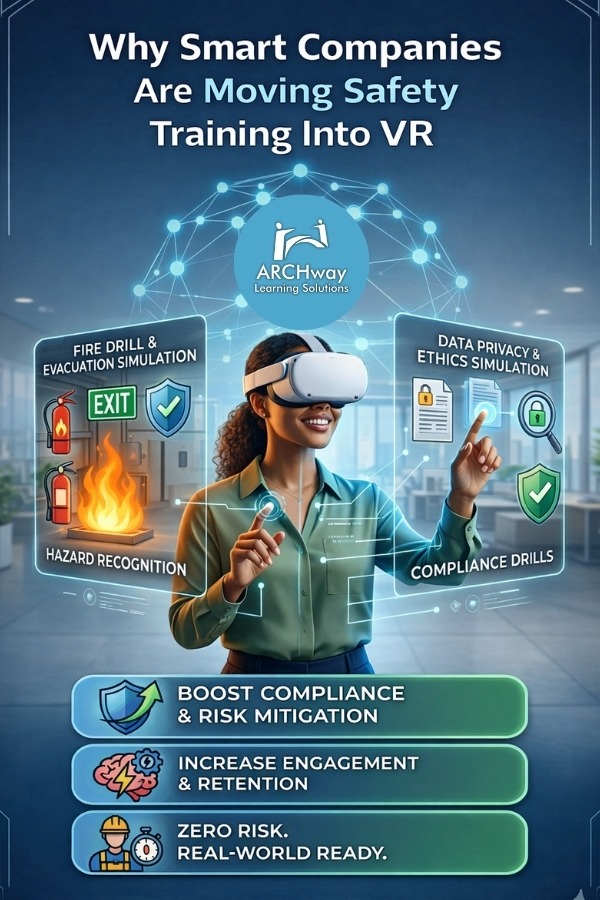
In manufacturing, teams can practice machine hazards, shutdown procedures, and emergency response before things go sideways on the floor.
In healthcare, staff can rehearse patient safety scenarios, infection control, and fast decisions in high-pressure moments where there is no room for guesswork. Workers can build awareness around fall risks, equipment zones, and site hazards before they ever set foot on a live project.
Warehousing, logistics, energy, and transportation teams can also use VR to prepare for the kind of split-second situations where safety training really has to hold water.
For CEOs, HR leaders, and L&D teams, this is not just a shiny training upgrade. It is a smarter way to reduce risk, improve performance, support digital transformation, and turn safety into a measurable business advantage.
Also read: How to Build a World-Class Virtual Reality Training Program for Your Organization
Here is the hard truth: most employees do not struggle with safety training because the content was confusing. They struggle because the real world is loud, stressful, fast-moving, and unforgiving.
That is why slide decks and policy manuals can only take you so far. They explain procedures, but they rarely recreate the split-second judgment, environmental pressure, and emotional stress that come with a real hazard.
VR closes that gap. Instead of asking people to imagine a forklift near miss, a chemical spill, a confined-space error, or a fire-response decision, it lets them step into the scenario in a controlled environment and practice the right response until it starts to feel second nature.
That shift is strategic. When training moves from passive instruction to active rehearsal, retention improves, confidence rises, and the organization gets closer to the one thing every executive actually wants: fewer preventable mistakes.
What makes VR so compelling is not the novelty. It is the business case behind it.
When done well, VR safety training helps companies train faster, standardize learning across locations, and collect better performance data than traditional classroom delivery ever could. That makes it relevant not only to safety leaders, but also to operations, HR, and the C-suite.
The biggest strength of VR is simple: people can make mistakes safely.
That matters because many critical scenarios are too dangerous, too expensive, or too disruptive to recreate live. You cannot casually simulate a major equipment malfunction, a warehouse hazard escalation, or a serious emergency drill at full intensity on a working site and just hope for the best.
VR makes those moments trainable. Teams can repeat the scenario, adjust their decisions, and learn by doing instead of just talking about it.
One of the hidden weak spots in safety training is variation. Different trainers explain things differently, different sites emphasize different risks, and different managers reinforce different standards.
VR creates consistency. Every learner can face the same scenario, the same triggers, and the same decision points, which is especially valuable for distributed teams or fast-growing organizations.
That consistency is not just operationally helpful. It strengthens compliance, improves audit readiness, and supports enterprise-wide quality standards.
What executives often dislike about training is not the cost. It is the fog.
They know money is going in, but they cannot always tell whether capability is actually going up. VR helps clear the air by generating performance data tied to decision-making, reaction time, hazard recognition, procedural accuracy, and completion trends.
That is where eLearning ROI becomes a real conversation instead of a vague promise. You are no longer measuring who showed up. You are measuring how people performed when it counted.
Busy leaders do not need another dashboard full of vanity metrics. They need signals that connect training to business outcomes.
VR makes that conversation stronger because it can surface data points that matter across departments, not just inside L&D.
Here are the metrics worth watching:
Time to proficiency for new hires or newly promoted frontline leaders.
Hazard recognition accuracy across teams or locations.
Decision quality under pressure in scenario-based exercises.
Repeat error patterns that may point to deeper process or coaching issues.
Training completion to operational readiness ratios.
Incident reduction trends after targeted interventions.
Those insights do more than justify a training budget. They help you see where risk is piling up, where behavior is improving, and where your people may need more support.
That is also where skill-gap analysis becomes far more useful. Instead of guessing where capability gaps exist, you can see them show up in scenario performance and respond before they turn into real-world failures.
Compliance matters, of course. But companies that stop there are leaving money on the table.
The smartest organizations use safety training to build a more resilient workforce. They understand that safety behavior reflects bigger organizational capabilities: attention, judgment, communication, situational awareness, and decision-making under stress.
VR supports those capabilities in a way static content simply cannot. It allows employees to practice not only what to do, but how to stay calm, assess risk, and respond correctly when conditions change.
That broader capability-building has downstream value. It can strengthen onboarding, improve supervisor readiness, and reinforce a culture where employees feel the company is investing in real preparation, not just covering its bases.
And that has people implications too. When employees feel genuinely equipped for the realities of their role, confidence improves. So does trust. Over time, that can positively influence employee retention, especially in industries where burnout and safety anxiety are very real.
It is easy to assume VR safety training belongs only to operations or EHS teams. It does not.
HR and L&D are in a unique position to connect safety capability with performance, engagement, mobility, and workforce planning. They can help frame VR not as a gadget, but as part of a broader talent strategy.
First impressions carry weight. When new employees step into high-risk environments, confidence and competence matter from day one.
VR can accelerate readiness by giving people early exposure to realistic situations before they face them on the floor, in the field, or on site. That reduces anxiety, shortens ramp-up time, and creates a more credible onboarding experience.
Supervisors often carry safety culture on their shoulders. Yet many are promoted for technical ability, not because they were trained to coach under pressure or lead through high-risk moments.
VR can help them rehearse the hard parts: intervention, escalation, communication, and judgment. That makes leadership development more practical, more relevant, and far less theoretical.
A lot of companies talk about digital transformation as if it begins and ends with systems. It does not.
Real transformation happens when people adopt better ways of learning, working, and responding. VR fits into that shift because it modernizes how capability is built, measured, and improved.
In that sense, VR is not a flashy side project. It is an infrastructure decision about how your company prepares people for complexity when push comes to shove.
The wrong question is, “Is VR impressive?” Of course it is.
The better question is, “Where would immersive practice reduce real business risk for us?” That is where ROI lives.
Leaders evaluating VR safety training should look for alignment in four areas:
Risk relevance: Are the scenarios tied to real hazards your workforce faces?
Measurement quality: Can the platform show performance, not just completion?
Operational fit: Can it scale across sites, roles, and training cycles?
Behavior impact: Will this change what people do when the pressure is real?
That framing keeps the conversation grounded. You are not buying technology just because it looks impressive. You are investing in a safer, sharper, more prepared workforce.
What is really happening here is bigger than training delivery. We are moving from content consumption to behavior rehearsal.
That shift matters because the future of L&D will not belong to organizations that simply distribute information well. It will belong to organizations that help people practice the moments that matter before those moments carry real cost.
VR is especially powerful in safety compliance training because the stakes are immediate and visible. But the larger lesson goes beyond safety: the more realistic the practice, the more reliable the performance. That is the name of the game.
And in a business environment where one mistake can affect people, productivity, compliance, and brand trust, that reliability becomes a competitive advantage.
So here is the question worth taking back to your leadership team: if your people can practice the highest-risk moments before they face them in real life, what excuse is left for relying on training that only tells them what to do?