
Picture this: Your company just invested a hefty chunk of change into state-of-the-art VR headsets. The hardware is sleek, the graphics are mind-blowing, and the initial demo leaves everyone in the C-suite saying, “Wow.” Fast forward six months. The headsets are gathering dust in an office closet. Completion rates are abysmal. The expected boost in performance? Nowhere to be found.
What went wrong? You fell victim to the “Shiny Toy Syndrome.” It is easy to assume that because virtual reality is immersive, it automatically teaches people better. But a headset is just a piece of plastic and glass. Without a solid foundation of instructional design, immersive learning is just an expensive video game. If you want your team to actually retain information, change their behavior, and drive business results, you have to look past the hardware and focus heavily on the learning design.
Also read: How to Build a World-Class Virtual Reality Training Program for Your Organization
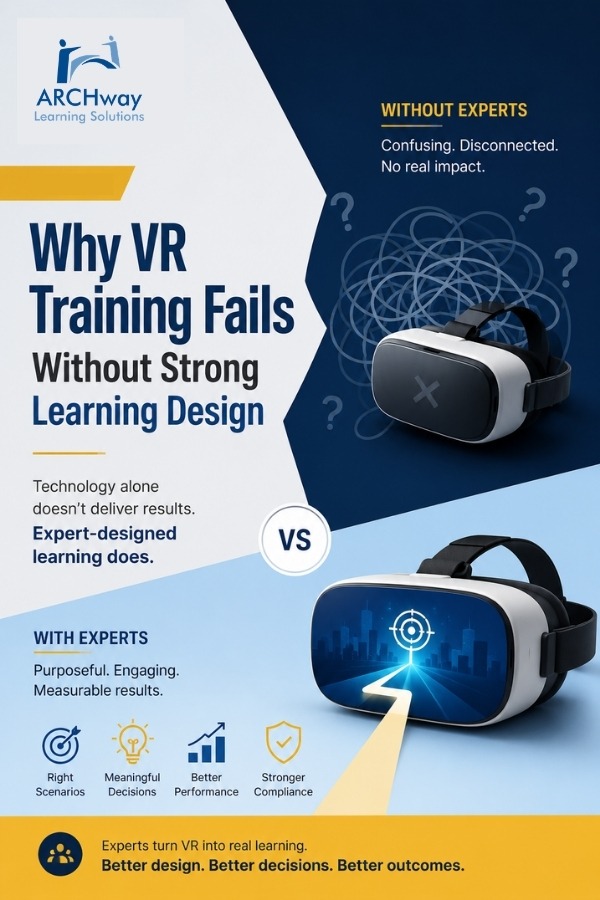
Let’s be honest – when you have a shiny new hammer, everything starts to look like a nail. But using corporate training VR just because it feels futuristic is a fast track to a bad ROI. VR is a powerhouse tool, but it is not a silver bullet for every corporate training need.
Imagine forcing an employee to put on a heavy headset just to read through an updated company policy or learn how to use basic project management software. It is massive overkill. A simple infographic or a short video will do the trick.
The Golden Rule of VR Training: If you can train it effectively on a flat screen or a piece of paper, do not build it in VR.
Where does VR actually earn its keep? It shines brightest when you use it for training that is otherwise too dangerous, too expensive, too rare, or too difficult to recreate in real life.
Consider how different industries leverage this sweet spot:
Healthcare: Medical simulations allow practitioners to experience the panic of a sudden intraoperative hemorrhage, making critical, life-or-death mistakes in a safe, simulated environment without risking patient safety.
Manufacturing: A plant technician can practice handling a catastrophic chemical leak. They learn how to shut down valves in the correct sequence while virtual alarms blare and smoke fills their field of vision. If they fail, nobody gets hurt.
Retail & Hospitality: Global giants like Walmart use immersive learning to prepare managers for the chaotic rush of Black Friday – building situational awareness and stress tolerance before the doors even open.
When you align VR with these high-friction operational problems, it ceases to be a novelty. It becomes a core driver of business metrics.
Why do some VR modules feel like a clunky 90s video game while others completely change how an employee does their job? The difference lies entirely in the scenario design.
A well-designed scenario acts as the beating heart of effective VR training. It’s not just about building a beautiful 3D model of a warehouse or a hospital wing. It’s about mapping out the invisible web of decisions, consequences, and cognitive leaps that a learner must make.
When an instructional design expert builds a VR scenario, they aren’t just writing a linear script; they are building a dynamic branch of choices. If a learner in a safety compliance simulation ignores a warning light on heavy machinery, the program shouldn’t just flash a red “Game Over” screen. It should show the realistic, cascading consequences of that choice. The machine overheats. Smoke fills the room. Emergency alarms blare. This immediate, visceral feedback loop is what builds true muscle memory.
Also read: Why Smart Companies Are Moving Safety Training Into VR
Furthermore, there is a common misconception that VR scenarios need to look exactly like a Hollywood movie to be effective. In reality, cognitive realism matters much more than visual realism. A learner doesn’t need to see every individual blade of grass outside the office window; they need the psychological fidelity of a high-pressure situation.
An expert learning designer knows exactly how to introduce deliberate environmental friction, such as:
Sudden Distractions: Introducing a loud coworker or a ringing phone while an employee is trying to execute a precise lockout/tagout procedure.
Realistic Pacing: Simulating a conversation with an upset, fast-talking customer to test a new hire’s active listening and de-escalation skills under pressure.
Ambiguous Choices: Creating real-world grey areas where there isn’t an obvious “perfect” choice, forcing learners to lean heavily on critical thinking.
Let’s face it: adults are a tough crowd. If your corporate training VR program feels childish, patronizing, or poorly put together, your learners will tune out within the first two minutes. They will see it as a gimmick or a waste of their valuable time. To get busy professionals, seasoned engineers, or stressed healthcare workers to take VR training seriously, the experience must respect their intellect and mirror their actual daily realities.
This is where poor learning design causes programs to fall flat on their face. If the dialogue in a leadership simulation sounds robotic, or if the safety protocols in a manufacturing module don’t match the actual workflow on the factory floor, you lose all credibility. Learners will check out mentally, or worse, scoff at the initiative entirely.
To build adult-grade immersive learning, you need a deep understanding of adult learning theory (Andragogy). Adults need to know why they are learning something, and they need to see immediate utility in the task.
When an expert designs these modules, they build intuitive, friction-free user interfaces so the learner spends zero mental energy figuring out how to use the controller, and 100% of their energy solving the actual workplace problem. When the environment reacts authentically to a learner’s choices, they stop feeling like they are testing a piece of technology and start feeling like they are doing their job.
Have you ever tried to learn a complex new skill while someone was shouting numbers at you, bright lights were flashing, and the floor was shaking? Probably not, because your brain would completely short-circuit. In psychology, this is known as cognitive overload, and it is the silent killer of poorly designed VR training.
Because virtual reality gives developers the power to build anything, untrained designers often build everything. They fill the virtual room with unnecessary ambient noises, flashing text boxes, complex spatial menus, and hyper-detailed backgrounds that have nothing to do with the actual learning objective.
When a human brain is placed in a fully immersive 3D environment, it is already working overtime just to process the spatial reality of the headset. If you stack a chaotic, cluttered user interface on top of that, the learner’s brain hits a wall. They become overwhelmed, frustrated, and in some cases, physically motion-sick. Instead of remembering the safety protocol, they just remember wanting to take the headset off.
Strong VR training design treats human attention as a precious, finite resource. Experts prevent this by utilizing a concept called “scaffolding”:
Phase 1: Start a new hire in a completely blank, quiet virtual room to learn the basic hand controllers without distractions.
Phase 2: Slowly introduce core environmental layers, such as the specific machinery or tools they will be interacting with.
Phase 3: Layer on realistic environmental sounds, background activity, and workplace pressure once basic muscle memory is locked in.
By carefully managing the learner’s cognitive load, you ensure they actually retain the data and feel confident using it on the job.
When a company decides to implement VR training, a common mistake is handing the project entirely over to a team of pure software developers or 3D artists. Now, don’t get us wrong – you absolutely need those talented technical minds to build the digital world. But asking a software developer to design a behavioral change program is like asking a bricklayer to draw up the architectural blueprints for a skyscraper. They can lay the bricks beautifully, but the building might still collapse if the structural integrity isn’t there.
Expert learning designers are the architects of your digital training space.
They translate complex compliance regulations into engaging, memorable storylines.
They turn abstract leadership concepts into concrete, interactive choices.
They ensure that every single interaction inside the headset serves a clear, measurable business objective.
For CEOs and HR decision-makers, hiring experts to handle your VR training design from inception to deployment isn’t an added expense – it is your insurance policy. Immersive technology requires a real investment of capital, time, and cultural buy-in.
Working with an end-to-end partner who provides consulting, intentional design, seamless implementation, and ongoing support ensures that your investment pays off. Experts keep you from making costly rookie mistakes, cut down your time-to-productivity metrics, and deliver a scalable program that actually moves the needle on your company’s bottom line.
Answer: Look at reduced training time, lower operational risks, and fewer real-world errors. VR programs regularly cut total training time by 30% to 40% while significantly reducing workplace safety incidents and live production downtime.
Answer: Not with proper learning design. Experts build intuitive, natural interactions – like reaching out to grab a physical tool rather than memorizing complex controller buttons. Most users get comfortable within minutes.
Answer: No, as long as you have the right backend. Modern cloud-based Mobile Device Management (MDM) systems allow you to deploy updates and track learner data across thousands of headsets worldwide simultaneously.
Have you taken the plunge into VR training within your organization, or are you still sitting on the fence? If you’ve experimented with it, did you hit any roadblocks with learner engagement, or did you find a sweet spot that transformed your onboarding?
Successful immersive learning is always a team effort between great technology and intentional pedagogy. If you are currently auditing your existing training programs or exploring how to build a scalable, expert-led VR framework for your organization, we are always open to exchanging ideas. Feel free to connect with our team for an informal consultancy chat to see how your operational goals can align with high-impact immersive design.
Drop your thoughts, stories, or burning questions in the comments below – let’s get a conversation going!